
Overview
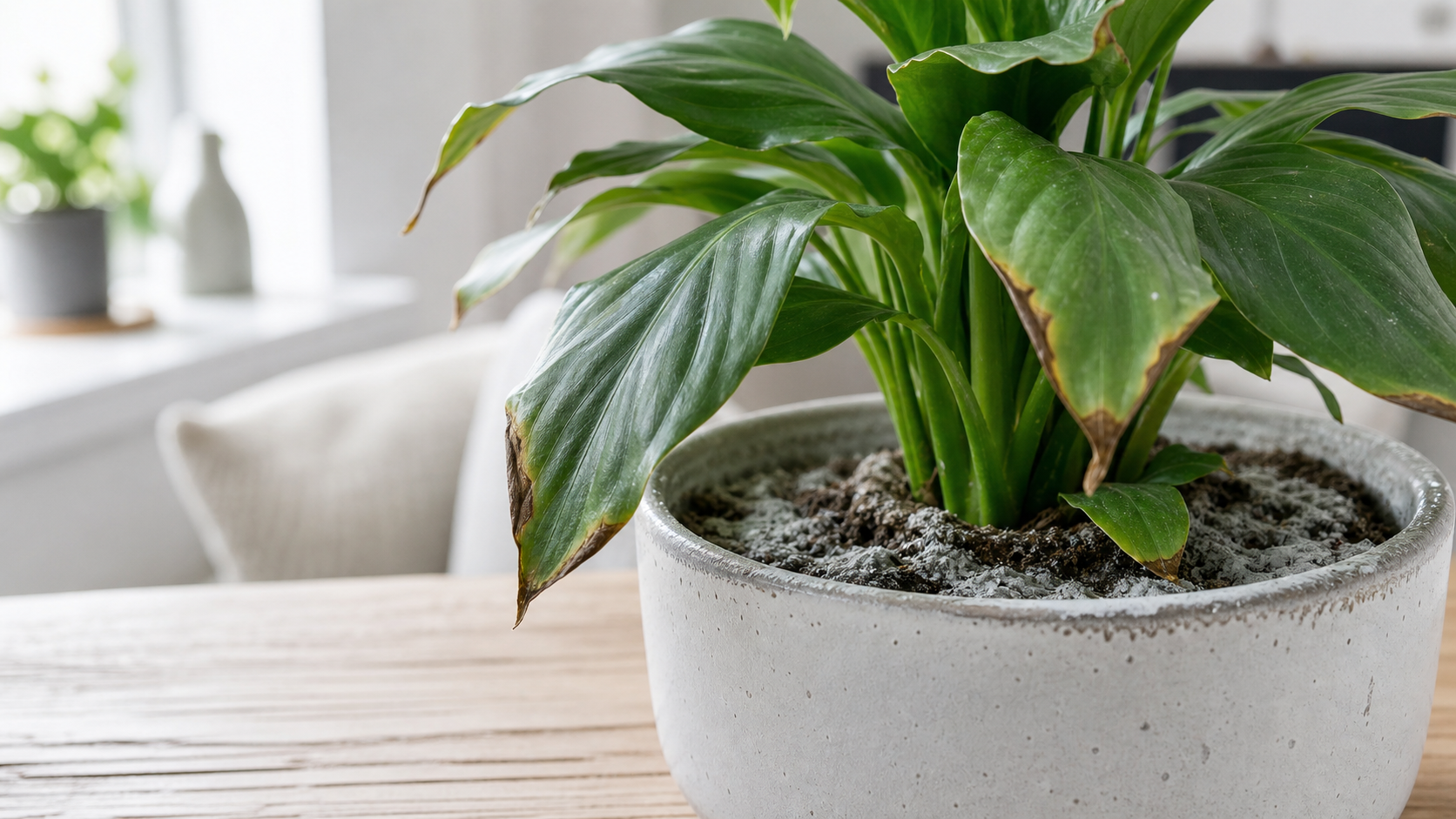
Soluble salt buildup commonly results from long-term overfertilization, mineral-rich water, or inadequate leaching. Salts increase osmotic stress in the root zone and impair water uptake, causing signs similar to drought or fertilizer burn, often accompanied by white crust on the pot rim or potting-mix surface.
How to identify it
Leaf tips and margins turn dry and brown, and the plant may wilt or grow slowly despite moist mix; white crystalline residue develops on the mix surface, pot rim, or near drainage holes.
Early signs and progression
A thin white crust appears on the pot rim while leaf tips develop uniform browning without pests or spreading lesions, especially following frequent feeding or prolonged use of mineral-rich water.
Without salt reduction, root tips remain damaged, marginal burn expands, leaves drop, and growth stalls; severe injury can kill roots and predispose the plant to secondary root rot.
Prevention
Fertilize according to growth stage and product labels, reducing feeding during dormancy or low light; periodically leach excess salts with ample water draining freely from the pot; avoid concentrated fertilizer on dry mix; use lower-mineral water for salt-sensitive plants where practical.
Lower-risk treatment
After confirming drainage holes are present, slowly flush the mix with ample clean water and discard all drainage; suspend fertilizer for several weeks. If the mix is compacted or heavily crusted, repot into fresh mix and remove dead roots.
Treatment steps
- Assess tip burn, white crust, and recent fertilizer or water-quality history.
- Confirm good drainage and remove obvious surface crust.
- Leach the potting mix thoroughly with clean water and discard all drainage.
- Pause fertilizer and monitor new growth and root-zone recovery.
- Repot and adjust water source and fertilization practices when severe or recurrent.
Chemical treatment and safety
No pesticide is needed. When feeding resumes, use clearly labeled fertilizer intended for container plants, begin at the low end of label rates, and avoid unintentionally combining controlled-release and liquid fertilizers.
Home remedies
- Water leaching — Slowly apply ample clean water over a sink so it drains fully from the pot, and discard drainage rather than allowing the pot to stand in salt-laden water.
- Remove salt crust — Remove visible white crust from the mix surface and wipe the rim. If deposits rapidly return, reassess water quality or replace the mix.
Referenced products
- Lower-mineral irrigation water — Useful for salt-sensitive plants or recurrent salt injury.
- Container-plant fertilizer — When feeding resumes, start at the low end of label directions.