
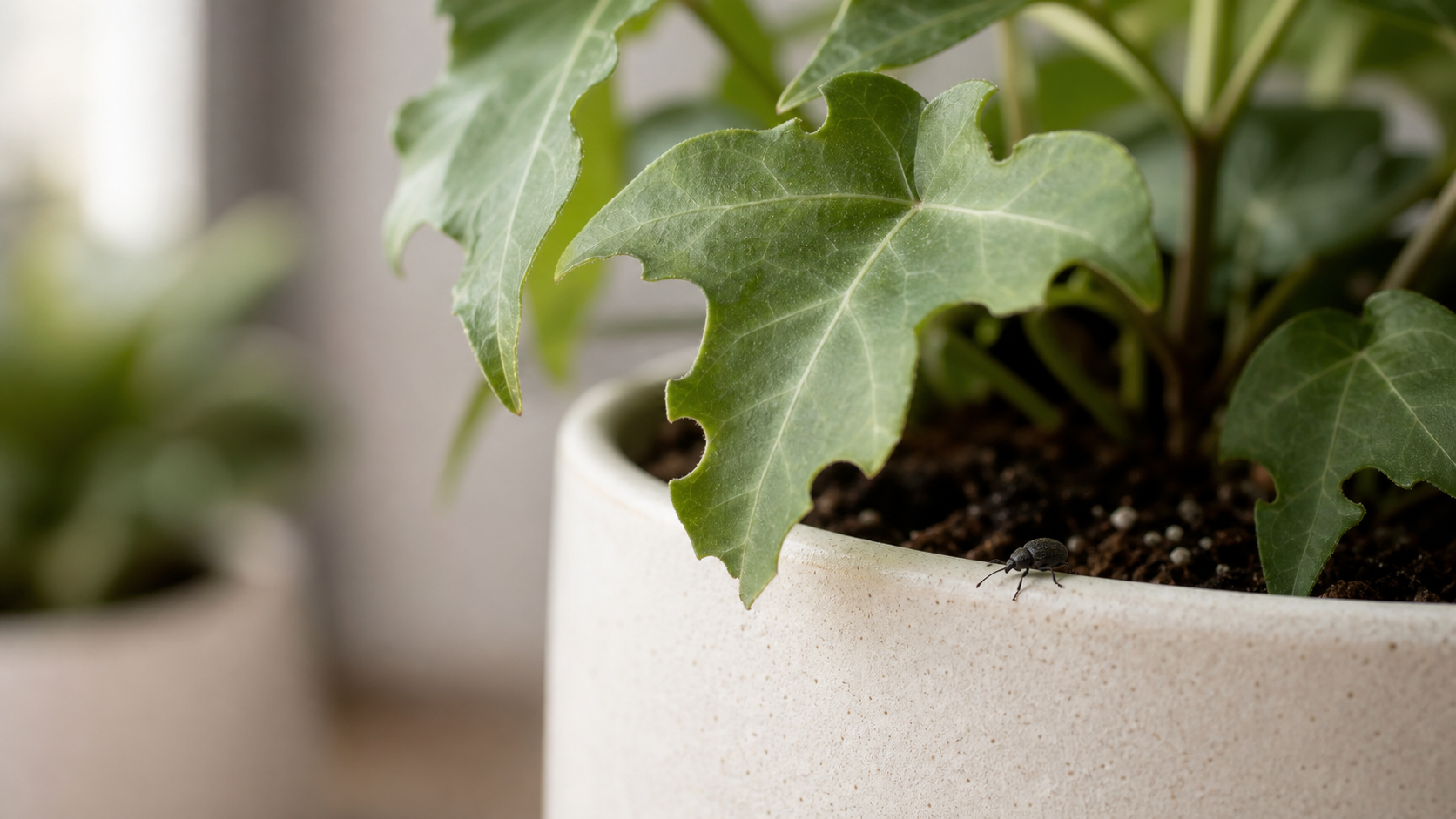
Overview
Black vine weevil can enter homes or patios with container plants. Night-feeding adults notch leaf margins, while cream-colored larvae in the potting mix feed on fine roots and the crown, causing serious damage to plants such as azalea, cyclamen, and ivy.
How to identify it
Leaf margins develop characteristic smooth semicircular notches; plants may suddenly wilt, loosen, or collapse. When unpotted, curved creamy legless larvae with distinct brown heads may be found feeding among damaged roots.
Early signs and progression
Fresh marginal notching often appears overnight while adults remain hidden during the day; reduced root anchorage when the plant is gently tested may indicate larval feeding in the mix.
Adult injury is often cosmetic, but larval root damage can quickly cause wilt and plant death. Moving infested containers or reusing potting mix can distribute larvae to other pots.
Prevention
Inspect purchased container plants for leaf notching and root-ball damage; do not reuse unknown old mix; examine patio plants before returning them indoors; inspect foliage and pot rims at night; isolate affected containers.
Lower-risk treatment
Use a flashlight at night to locate and hand-remove adult weevils. For wilted plants or suspected root injury, inspect the root ball, remove found larvae and severely contaminated mix, repot into clean mix, and isolate for observation.
Treatment steps
- Isolate containers with characteristic marginal notching.
- Inspect at night and remove adults.
- Unpot wilting plants to check for legless white larvae and crown injury.
- Remove larvae and contaminated mix and repot where necessary.
- Monitor for fresh notches and recovery, and consider labeled larval controls where appropriate.
Chemical treatment and safety
For larvae, locally registered beneficial nematode products or other products labeled for black vine weevil in containers may be considered. Adult controls must likewise follow local labels, especially indoor-use and site restrictions.
Home remedies
- Night collection — After dark, inspect leaf margins, pot rims, and benches with a flashlight, remove adults found, and track whether fresh notches continue.
- Root-ball inspection — Gently unpot persistently wilting plants and look along the root-ball edge for curved white larvae; remove contaminated mix and repot when found.
Referenced products
- Inspection flashlight — Use at night to find adults concealed around leaves and containers.
- Labeled beneficial nematode product for weevil larvae — Apply to potting mix only under locally labeled conditions and suitable temperature and moisture.