
Overview
Learn to accurately identify scale insect life stages and determine when intervention is needed by observing physical signs and activity
Scale insects are common piercing-sucking pests on indoor woody plants, often preferring stems, petiole junctions, and other concealed areas. This article focuses on how to identify crusty bumps, honeydew secretions, and insect activity to distinguish between old shells and active infestations, enabling timely and targeted treatment.
Typical Appearance and Texture of Scale Insects
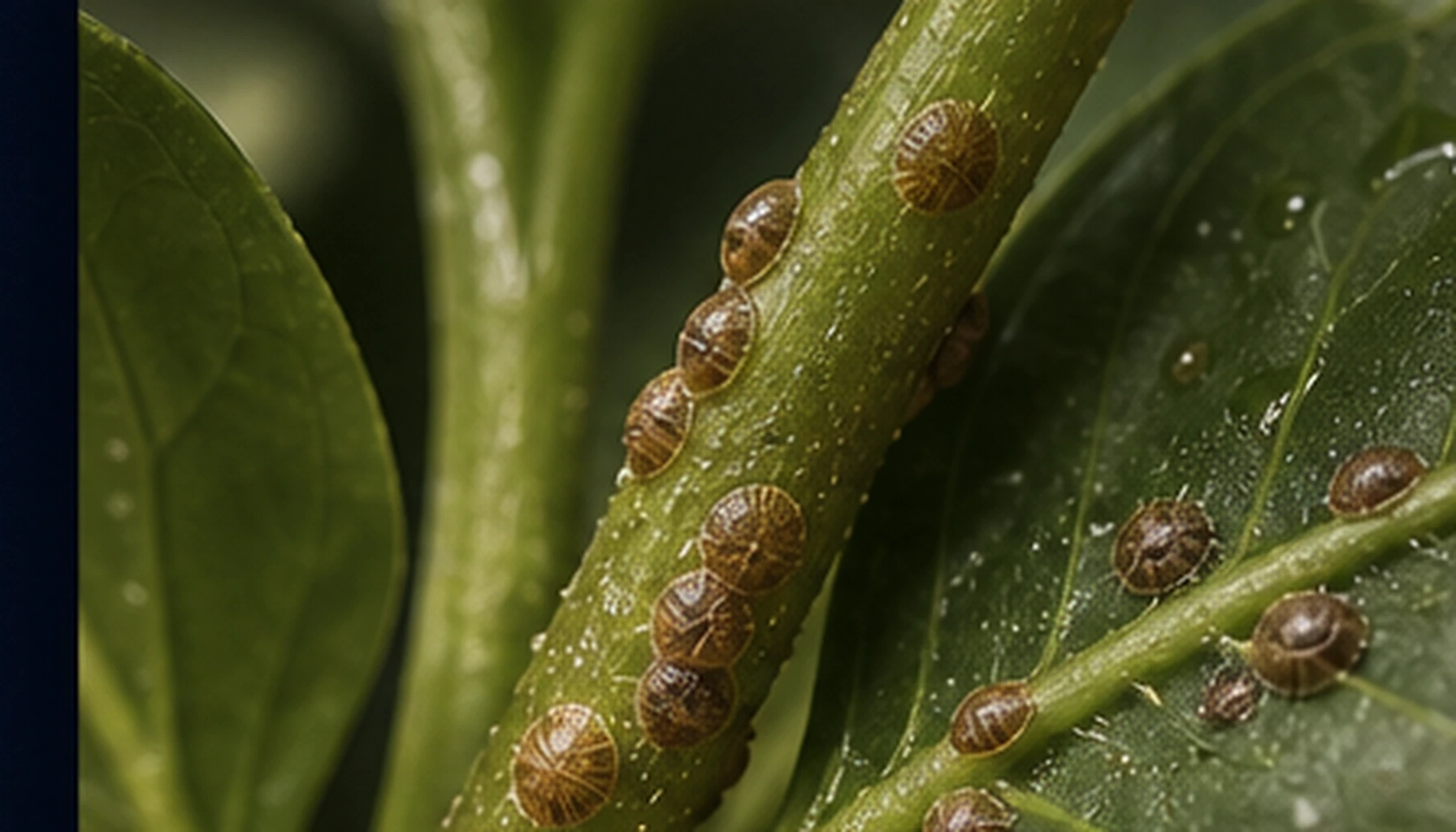
Scale insects are tiny, and mature individuals are covered with a waxy or hard shell that resembles a brown or dark gray cap pressed tightly against plant tissue. Adults are typically 2 to 5 millimeters in diameter and no more than 1 to 2 millimeters in height. When gently scraped with a fingernail, live scale shells do not fall off easily, feeling firm with slight elasticity; dead shells are dry and brittle, crumbling or peeling off with minimal contact.
The most common armored scales have round or oval shells with concentric rings or radial textures on the surface. Soft scales and mealybugs often form soft, cotton-like wax layers that appear more like white powder or fluff, attaching to stem joints, leaf base crevices, and petiole connections.
Honeydew: The Key Signal of Active Feeding
Scale insects feed by piercing plant phloem and excrete large amounts of sugar-rich waste fluid called honeydew. When the following characteristics appear on stems, it indicates live scale insects are actively feeding:
Note that old shells may also retain some dried honeydew residue, but typically not in continuous patches, not greasy, and not causing widespread sooty mold. If honeydew continues to appear and new shells are being generated, it indicates an active infestation.
- Sticky, glossy liquid residue on stem surfaces, especially below dense insect clusters.
- Honeydew dripping onto lower leaves or soil surface, forming greasy transparent spots that dry into gray-white powder.
- Honeydew attracting sooty mold fungi, creating black mold layers on stems and leaves that look like ink smears.
Distinguishing Old Shells from Live Insects
Accurate differentiation determines whether immediate treatment is necessary. Here are practical field assessment methods:
- Color and Sheen: Live scale shells have uniform, darker colors with natural luster; old shells appear dull, grayish-yellow, or faded with no sheen.
- Shell Integrity: Gently touch the insect body—live shells are tightly adhered and difficult to move; old shells often have subtle gaps between themselves and the stem, feeling loose when prodded.
- Edge Examination: Using a 10x handheld magnifying glass, observe the insect edges—live scales show slightly raised breathing pores or hatching openings; old shells have intact, closed edges with no life activity.
- Honeydew Persistence: Observe continuously for three to five days—if honeydew continues to be freshly secreted, active infestation is highly likely; if the surface is dry and clean, it is likely residual old shells.
Key Observation Procedures
Inspection should prioritize the stem base, areas around pruning wounds, petiole connections, and leaf undersides—typical hiding spots for scale insects. Maintain adequate lighting during examination, using a flashlight at an angle if necessary to create shadows that make tiny bumps easier to identify.
Do not make global assessments based on a single insect. Mark discovery locations across the entire plant, record insect density and honeydew distribution to evaluate treatment effectiveness later.
First Steps After Confirming Active Infestation
Once live scale insects are confirmed, immediately spraying broad-spectrum chemical pesticides is not recommended. Instead, use a soft brush dipped in diluted mild soap solution to gently scrub visible insects along stems, focusing on dense infestation areas. Rinse the stem surface with clean water, and after complete drying, apply low-toxicity formulations containing mineral oil or neem extract to insect distribution zones, concentrating on stem joints and petiole bases.
If insects have spread to multiple stem sections with high density, systemic insecticides may be used under professional guidance, but safety intervals must be strictly observed to avoid contaminating the indoor environment.
Changes to Monitor After Treatment
Within three to seven days after treatment, focus on observing whether live insect tissue can still be scraped out, whether honeydew secretion has stopped, and whether sooty mold layers are drying and falling off. If old shells remain but no new honeydew is present, active individuals have likely been controlled and natural shedding can be awaited.
Re-examine the stem surface after two weeks. If no new shells are forming, honeydew has completely disappeared, and leaf gloss is recovering, treatment is essentially successful. If new shells continue to appear, reassess the treatment plan, considering changing active ingredients or strengthening localized treatment.
Regular monitoring should continue for six to eight weeks because scale insect eggs may hatch in batches under suitable conditions, and missed nymphs can re-establish populations weeks later.