
Overview
Managing Humidity, Airflow, and Watering Strategies for Healthy Plants in Cooled Indoor Spaces
The low-temperature, dry environment of air-conditioned rooms often causes plant leaf edges to dry out, curl, or turn brown. This article provides a systematic solution for indoor plant keepers across four dimensions—observation, cause analysis, countermeasures, and outcome evaluation—to help you maintain air-conditioning comfort while creating a suitable growth environment for your plants.
1. Recognizing the Signs of Dry Leaf Edges
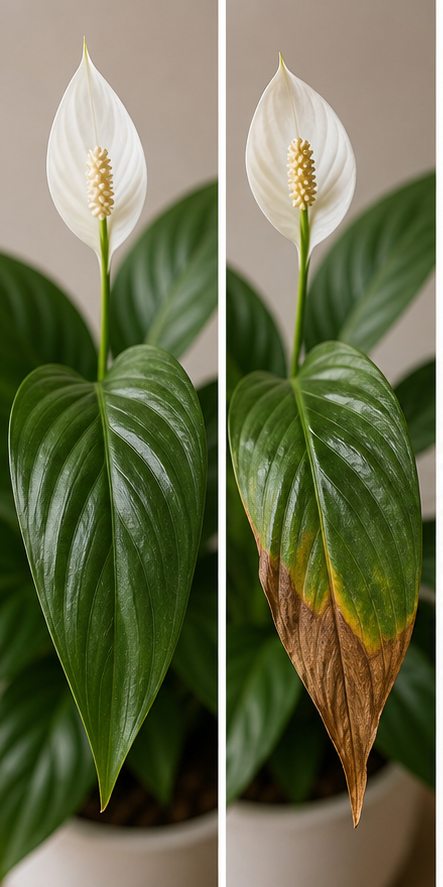
In air-conditioned environments, dry leaf edges are the most common warning signal for plant distress. The key observation points include: whether leaf edges are turning yellow or brown, whether the texture has become brittle and fragile, and whether leaf flexibility has decreased. When you notice these symptoms, it's essential to investigate environmental factors immediately rather than hastily adjusting watering frequency.
It's worth noting that new leaves and old leaves on the same plant don't respond to dryness simultaneously. Old leaves typically show edge dryness first, while new leaves may remain relatively intact because plants prioritize directing water to their growing points. If you only find symptoms on older leaves, it often indicates the problem has persisted for some time.
2. Analyzing the Core Impacts of Air-Conditioned Environments
The effects of air-conditioned rooms on plants manifest mainly across three aspects: rapid humidity decline, frequent temperature fluctuations, and uneven airflow distribution. During cooling operation, standard household air conditioners typically reduce indoor relative humidity to below 40%, while most indoor foliage plants require 50% to 70% humidity to maintain healthy leaves.
Another commonly overlooked issue is direct cold airflow exposure. When air conditioner vents face or angle toward plants, continuous low-temperature airflow accelerates moisture evaporation from leaf surfaces, leading to localized dehydration and temperature stress. In such cases, even if you increase watering frequency, leaf edges will continue to dry out.
3. First-Step Countermeasures
After identifying dry leaf edge symptoms, the first action should be to reassess the plant's placement. Move plants at least 1.5 meters away from air conditioner vents. If space is limited, use screens, bookshelves, or other furniture as physical barriers to block direct airflow.
Secondly, immediately stop any potential overwatering behaviors. Soil drying rates differ between air-conditioned rooms and regular rooms, and overwatering in low-temperature environments more easily leads to root rot. Root damage further aggravates leaf dehydration. Before watering, check the humidity of the top 2 centimeters of soil—only water when the soil is completely dry.
4. Specific Methods for Increasing Humidity
Increasing localized humidity is the most direct improvement method. The simplest approach is to place a tray beneath the plant, adding pebbles or expanded clay pellets to the tray, then pouring water to halfway up the pebble height. This keeps plant roots away from standing water while raising relative humidity around the leaves through water evaporation.
For rare plants or those with higher humidity requirements, consider using a small humidifier. Position the humidifier near the plants to maintain steady mist output, but maintain appropriate distance to avoid prolonged moisture on leaf surfaces, as this can also trigger fungal diseases.
5. Common Mistakes to Avoid
Several common mistakes require particular attention when caring for plants in air-conditioned rooms. First, frequent leaf misting. Many caretakers believe spraying can quickly raise humidity, but in air-conditioned environments, water evaporates so rapidly that frequent misting can actually cause moisture to remain on leaf surfaces during cooler nighttime hours, creating conditions for fungal infections.
Second, placing plants directly beneath air conditioner vents to let them 'enjoy the coolness.' This practice causes plant temperatures to drop rapidly, affecting normal physiological metabolism functions.
Third, blindly increasing watering frequency. Water evaporation and soil drying patterns in air-conditioned rooms differ completely from warm-season conditions. You need to re-establish watering rhythms based on actual circumstances.
6. Observing Results and Making Adjustments
After implementing improvement measures, typically one to two weeks are needed to observe noticeable changes. During this period, focus on observing these indicators: whether new leaf growth rate is normal, whether new leaf edges show drying, and whether existing dry areas have stopped spreading. If no improvement is seen after two weeks, further investigation for root issues or nutrient deficiency is necessary.
For caretakers maintaining plants in air-conditioned rooms long-term, reassessing plant conditions during seasonal transitions is recommended, as changes in air conditioner usage frequency directly impact indoor microclimate. If your region requires prolonged air conditioning use in summer, proactively adjusting plant placement and care strategies will be more effective than补救 after problems arise.